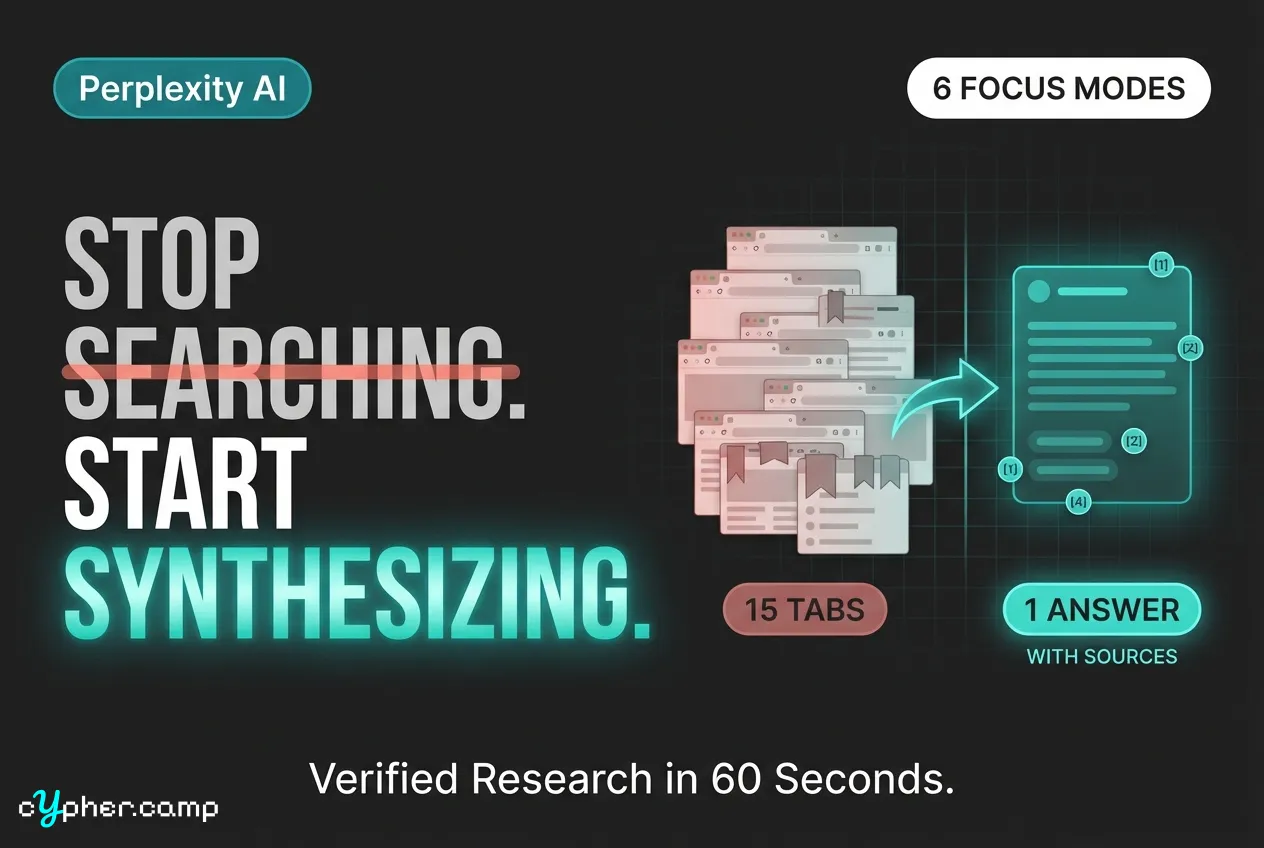
It's 11 a.m. and you have fifteen tabs open, half of them ads, trying to confirm one fact before a meeting. A colleague who switched to synthesis search answered the same question two minutes ago and moved on. The work has quietly changed: it used to be 'find the page,' now it's 'verify the answer.' Most operators haven't noticed, and they're still hunting.
Search shifted twice in two years. Google still hands you ten blue links and a sidebar of ads. Perplexity reads the sources and hands you an answer with citations. ChatGPT hands you an answer with no citations at all. The mistake most people make is to trust whatever synthesis comes back, because it sounds confident, without ever checking whether the sources hold. That's how a clean-looking answer becomes your mistake in front of a client.
What you build is a daily research workflow you actually use plus a decision memo saved outside the thread: a verified answer, its sources, and the next action, captured in Collections and exportable as professional citations, not trapped in a chat you'll never find again.
The mechanism is charter first, search second, contradiction always. You learn the Research Question Formula that structures a query so synthesis works for you, the six Focus modes (Academic, Writing, YouTube, Reddit, and more) with the reflex for when to reach for each, follow-up chains that dig deeper without starting over, and a 5-point source-verification checklist that catches synthesis errors before they spread.
Speed and proof, from the real course: across 4 modules and about 3 hours, you complete your first verified research in the opening 60 seconds. By Hour 1 you have Focus-mode mastery and the verification habit. By Day 1 you're running full professional workflows: morning briefing, quick lookup, deep dive, and verification. The Mastery Lab walks one real research decision end to end so the loop is yours, not just a demo you watched.
Why now, and the sovereignty frame: when your research lives inside a Cloud Landlord's product, your queries, your reading patterns, and the synthesis you trust are theirs to log, train on, monetize, or revoke. For general work that trade is fine; the tools are sharp, so use them. For research that touches IP, M&A, or legal strategy, you graduate the load-bearing pieces to a local stack (Open WebUI plus Brave Search plus a local model) that gets sharper every quarter. That two-tier move, cloud for speed, local for what you can't afford to leak, is the same keys principle crypto teaches, applied to your research.
You start from zero. This is a beginner-level course; every move is demonstrated before you run it, and you can't break anything. You finish with a workflow you rely on, a verification habit you trust, and a clear rule for when to swap to local, owning your judgment instead of renting someone else's answer.