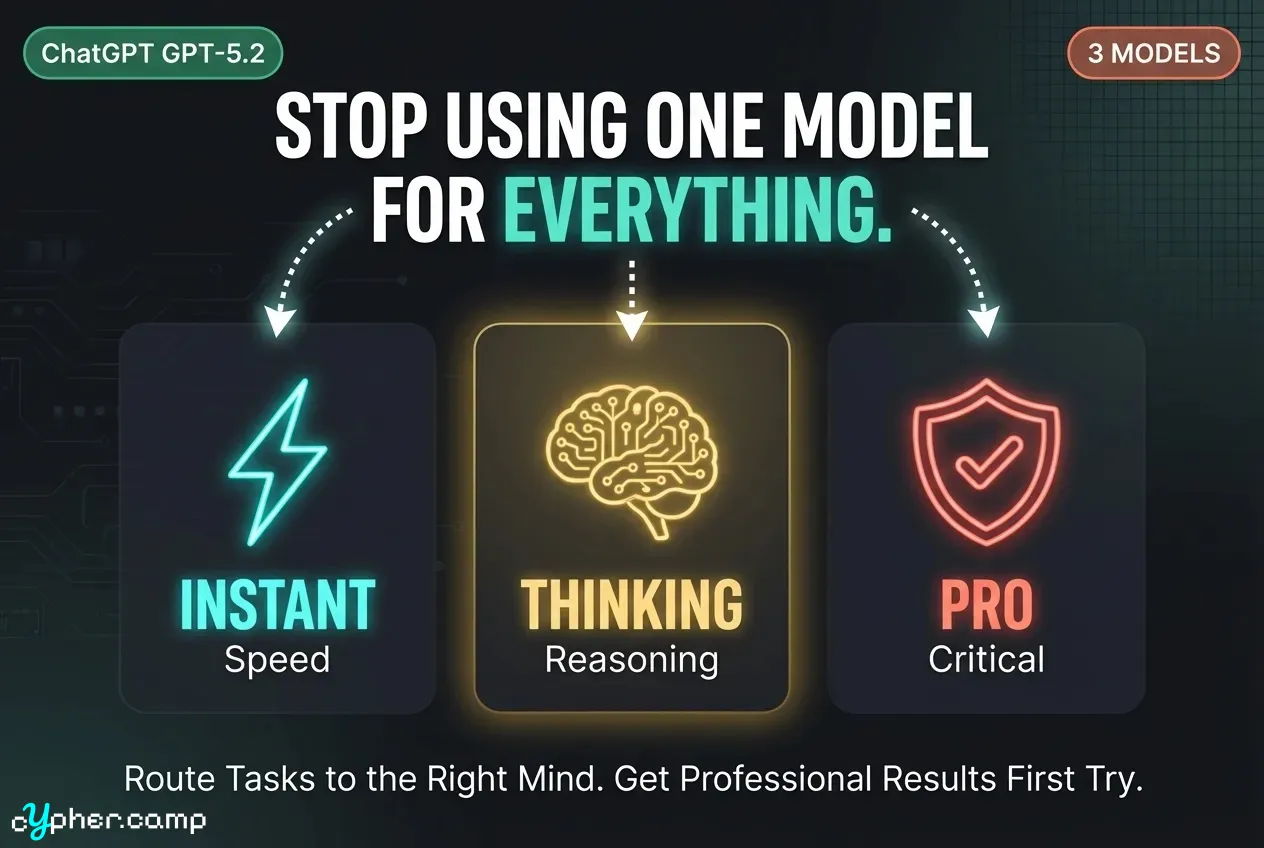
It's 9 a.m. and you open ChatGPT the way most people do: one box, one question, whatever answer comes back. You don't notice there are four different models behind that box, each built for a different kind of work. So you run a board deck through the same model you'd use to reword an email, and you wonder why the output feels flat.
Here's the mistake almost everyone makes. They treat ChatGPT as a single magic chat and bond to one thread. The operator treats it as an operating system: pick the right GPT-5.5 variant for the job, keep your context and instructions outside the chat, and save the workflow so it runs again tomorrow without you rebuilding it from scratch.
What you'll actually build: a complete daily workflow that routes every task to the right model, a set of Custom Instructions and Memory tuned to your style and situation, and at least one Custom GPT (email writer, research assistant, meal planner) that handles a recurring job on its own. By the final Mastery Lab you deploy one ChatGPT operating system you can hand to tomorrow's version of yourself.
The simple mechanism is the Model Picker plus the Specification Paradigm. You learn why a well-specified prompt works on the first try, and you build the reflex to route in about 5 seconds: Instant for everyday questions, Thinking for deep reasoning that shows its work, Pro for the hardest tasks, Mini when you want most of the quality for a fraction of the cost.
Speed and proof, from the real course: across 3 modules and roughly 2 hours 35 minutes, you produce your first GPT-5.5 masterwork in the opening 60 seconds. By the end of Module 1 you can pick the right model on instinct. By Module 2 you're running Code Interpreter on a real spreadsheet to pull charts, summaries, and insights, and using long-context conversations that stay sharp over hundreds of messages. By Module 3 you're generating DALL-E 3 images from structured prompts and chaining models into one pipeline.
Why now: Codex and AI agents are turning ChatGPT from a chat box into a work partner, and the people who learn to direct it, instead of being directed by it, pull ahead this year, not next. You'll also learn exactly when ChatGPT beats Claude or Gemini and when it doesn't, so you stay portable across models instead of married to one vendor that can change the rules on a Tuesday.
You start from zero and you can't break anything. No prior prompt-engineering background is assumed; every move is demonstrated on real tasks first. You finish owning a workflow and a set of custom tools you direct, not a chat history you hope is still good tomorrow.