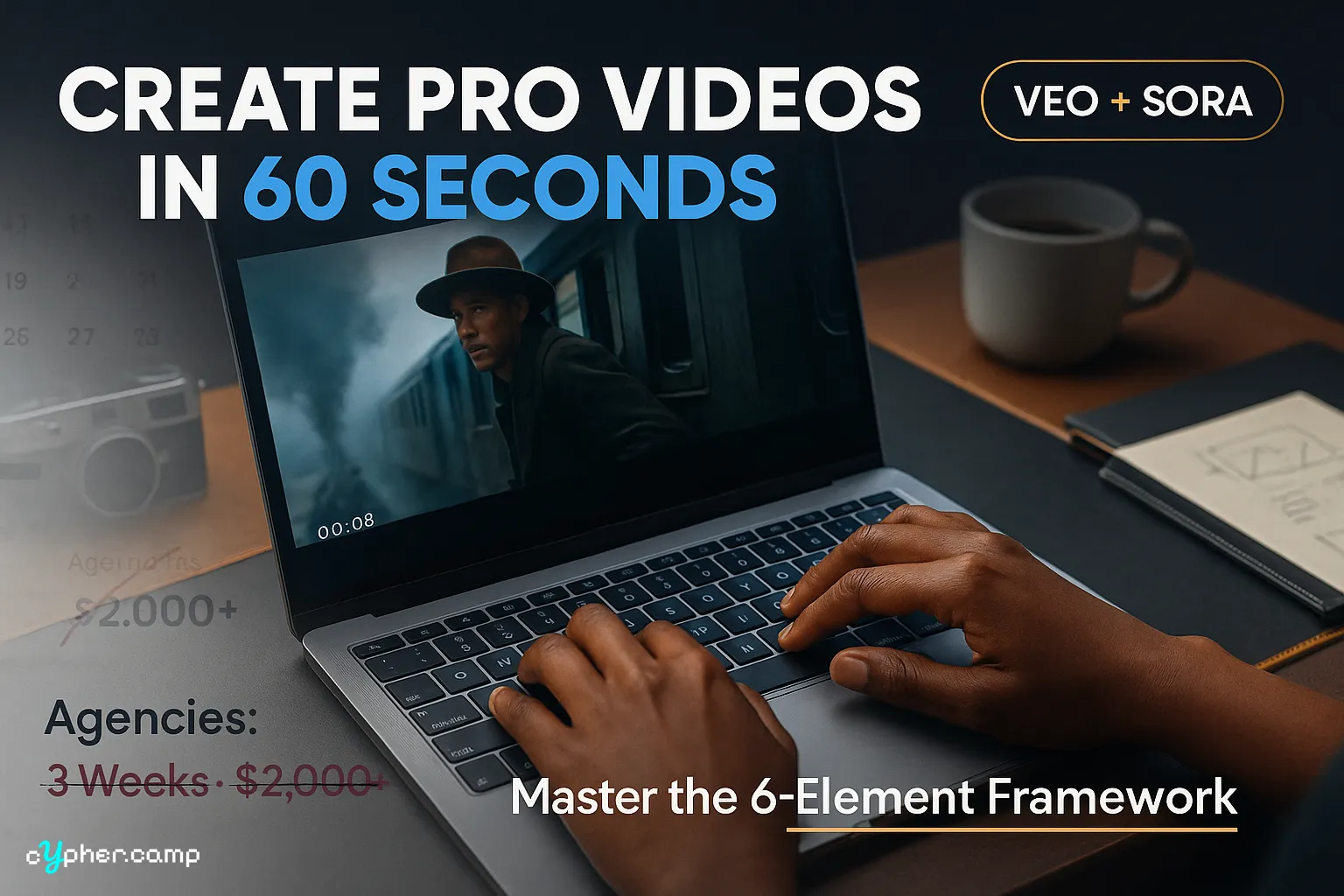
You're staring at a quote: $2,000 and three weeks for a video you're starting to suspect you could make yourself. Meanwhile the deadline is Friday. Across the table, someone on another team just generated a usable clip during the meeting while the agency was still emailing timelines. The gap isn't talent or equipment. It's that they know the framework and you don't, yet.
Here's the mistake most people make with AI video: they treat it like a slot machine, type a vague idea, pull the lever, and hope. The output looks amateur, so they conclude AI 'isn't there yet.' The professional knows it's not about luck or gear. It's about prompting with structure and knowing which platform to use when.
What you build is a portfolio of 10 client-ready videos during the lessons, service demonstrations, client proof, and social cuts for Instagram and LinkedIn, the concrete evidence that positions you as the video AI specialist your team or clients depend on.
The mechanism is the 6-element video prompting framework: Motion, Subject, Environment, Camera, Lighting, and Audio. It works reliably across both Veo 3 and Veo 3.1, and you pair it with platform-specific patterns that fix amateur mistakes before they happen, plus a quality-diagnostics method that repairs a weak video in a single iteration instead of ten random retries.
Speed and proof, from the real course: across 3 modules and about 3 hours 40 minutes, you generate professional 4-8 second videos in minutes instead of weeks. Day 1 you ship your first professional clip. Week 1 you complete 5-8 portfolio pieces. By Module 2 you're building strategic videos you'll actually use and transferring them to social platforms. Module 3 covers the premium techniques, multi-scene sequencing that looks professionally edited, that justify $500-1,000 client pricing, and the Mastery Lab turns one raw idea into a paid client-ready brief. (Foundation-tier users complete about 70 percent and master the core framework; Module 3 clearly marks the optional upgrade.)
Why now: companies are hiring video AI specialists today, and the gap isn't the tools, you already have them, it's knowing exactly which tool to use when and how to prompt so the result looks like days of production, not seconds. The people who close that gap first become essential at work this quarter.
You start from your first prompt. Every element is demonstrated before you use it, and the quality framework means a weak result is a diagnosis, not a dead end, so you can't really get stuck. You finish owning a repeatable framework and a portfolio you direct, the operator who makes the video while everyone else is still waiting on a quote.